# Building a Leetcode Contest Percentile Analyser
## Motivation for doing this
I got into practising DSAs daily back in 2020 when I was preparing to job hunt -- shortly after resigning from my previous job with nothing squared up.
I went through Stanford's course on DSAs on coursera and loved every bit of it. Then I walked through about 3 personally picked problems each day for maybe a month or two, [keeping problem notes on Github](https://github.com/Nnadozie/learningNotes), and not really tracking any metrics but focusing on truly understanding what I was doing.
However the first time I put that practice to the test with a Microsoft code assessment I came in at the bottom 36th percentile. It was really disheartening looking at those problems I could solve, especially the graph problems, but knowing I wasn't moving fast enough to solve them optimally and correctly.
Anyway, shortly after that I got an offer for a fully remote role which I took so I never really bothered to reflect and improve on my practice process. Until now.
%[https://twitter.com/dozieokk/status/1479391181683539973?s=20]
Since my tweet [I've taken part in one contest](https://twitter.com/dozieokk/status/1479847684592881668?s=20) and have been wondering how best to get back into practice. Do I refresh my theory first? Which platform should I use? What language do I use? e.t.c e.t.c. But most importantly, HOW do I practice -- what do I track?
Well yesterday I finalized on tracking speed of completion with the goal being to get into the top 10 percent (90th percentile) on Leetcode contests. And as with any competitive sport I need to constantly know where I stand against other players so I can appropriately track progress.
Unfortunately leetcode holds contests at most only once a week, so I decided to use past contests problems, time myself, and see where I would have placed based on my completion time if I had taken part.
## Why not just do this manually?
Leetcode already ranks competitors, and it'd be super easy to just find out what rank falls within the top 10% within each competition and look at how long that person took to compare against my completion time. But for at least once in my life I wanted to be like every developer ever:
> Spend 10 hours automating a task that will take 1 min to do manually.
And very importantly write about it 🤡 . (I recently joined an accountability group where we each have to write 1000 words a day and I need stuff to write about 😭 😭 )
## Initial attempt
### Research Findings
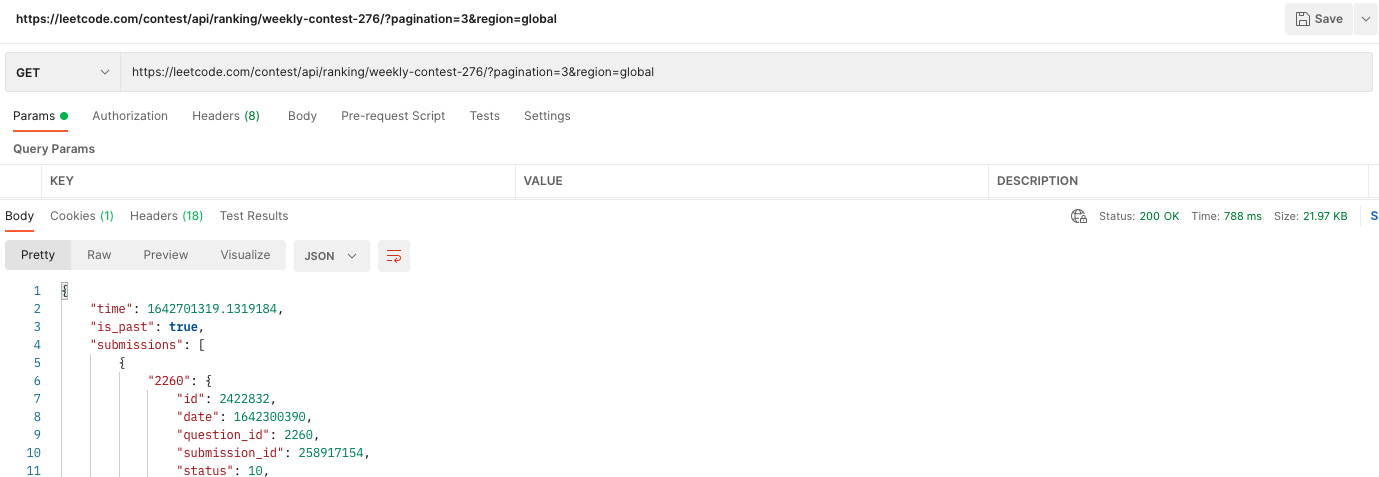
Leetcode returns contest data in pages of 25 results each. Getting all this data requires paginating through hundreds of pages.
I noticed the get request they use to get this page data doesn't require authentication, but it does have pagination enforced, so I decided I'd start with simply pulling in data from all pages of a contest.
### Package Structure
I opted to create a simple yarn package and pull in axios and typescript, while writing my output to a local file.
### Build and run process
I initially ran the script using two commands:
```
> yarn tsc app.ts
> node app.js
```
but I quickly got tired of that and combined these into one yarn start command:
```json
...
"scripts": {
"compile": "tsc app.ts",
"start": "yarn compile && node app.js"
},
...
```
So now I just run `yarn start`.
### First draft of data fetching
The idea here was simple: while we haven't found a user who didn't make a submission, go through each contest page starting from the first one and push to an array containing all user's records with the records found on each new page.
```ts
const axios = require('axios');
const fs = require('fs');
interface ranker {
rank: string;
finish_time: number;
}
const competitors: ranker[] = [];
async function getUsers(url: string): Promise {
try {
const response = (await axios.get(url)) as { data: { total_rank: ranker[] } };
return response && response.data && response.data.total_rank;
} catch (error) {
console.error(error);
}
}
async function buildCompetitors() {
let res: ranker[];
let page = 0;
do {
res = await getUsers(
`https://leetcode.com/contest/api/ranking/weekly-contest-276/?pagination=${page}®ion=global`,
);
competitors.push(...res);
console.log(`https://leetcode.com/contest/api/ranking/weekly-contest-276/?pagination=${page}®ion=global`);
console.log(process.argv[2]);
fs.writeFile(process.argv[2], JSON.stringify(competitors), (err) => {
if (err) throw err;
console.log('file saved');
});
page++;
} while (res.find((val) => val.finish_time === 0) === undefined);
}
async function main() {
await buildCompetitors();
}
main();
```
I let this run and went to bed, then came back to an error informing me that finish_time never gets to zero.
Okay fine, the error wasn't THAT polite:
```
(node:52369) UnhandledPromiseRejectionWarning: TypeError: Cannot read property 'find' of undefined
at /Users/nnadozieokeke/leetcode-analysis/app.js:82:29
at step (/Users/nnadozieokeke/leetcode-analysis/app.js:32:23)
at Object.next (/Users/nnadozieokeke/leetcode-analysis/app.js:13:53)
...
```
but looking at it, it's really straightforward to see that res is only undefined if we've exhausted all possible objects, therefore the while condition is never true.
### Figuring out why finish_time is never 0
Initially, when inspecting Leetcode's network requests I noticed the objects in each page had a finish_time property, and I just assumed this will tend to 0 and that partly informed my initial approach. But as I just stated above, it doesn't.
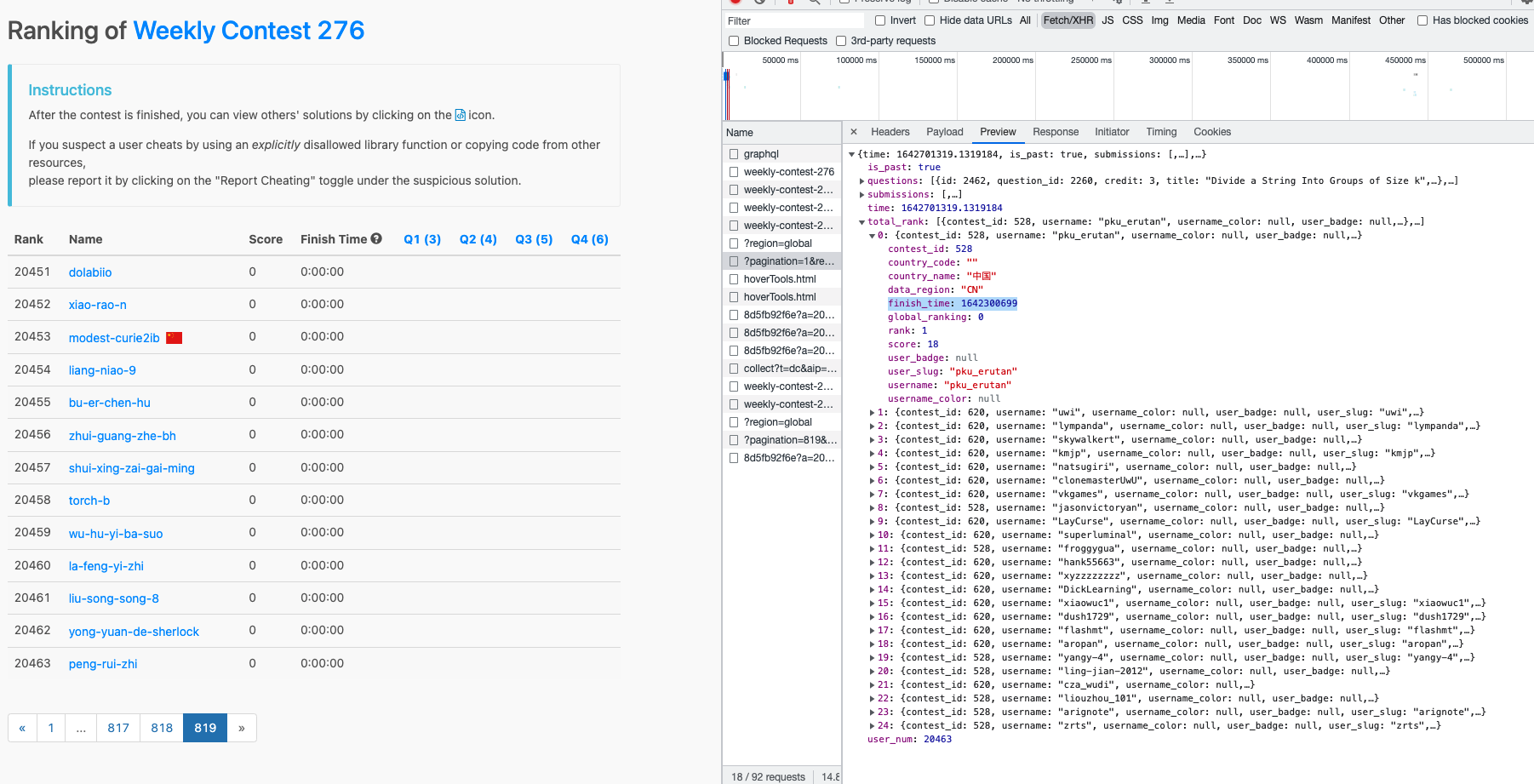
And try as I might, I couldn't figure out how to parse a single finish_time value to the table's corresponding Finish Time. **Curious to know if anyone figures this out (Please comment)**. One thing I noticed is that the finish_time values increment as though counting seconds and this helped me change tact.
Rather than decode the time format Leetcode uses, I decided I'd find the value corresponding to a Finish Time of 00:00:00, then use that to convert other values to HH:MM:SS format by simply finding the difference in values.
### Finding the finish_time value corresponding to 00:00:00
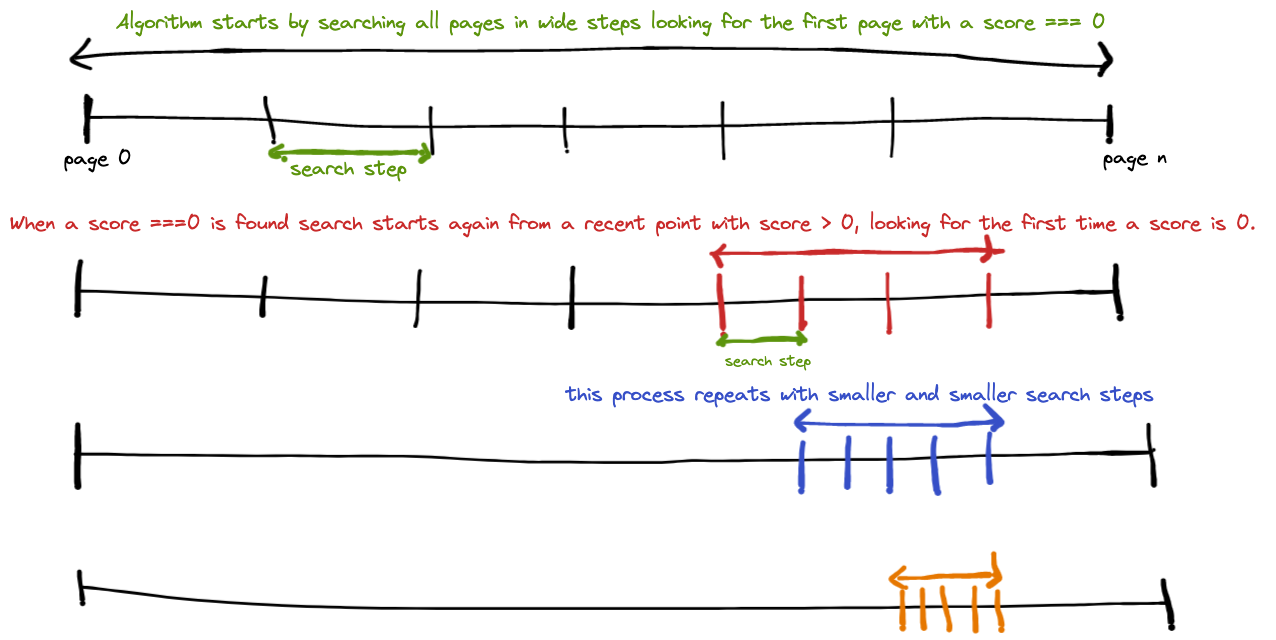
This value is typically on the first page with an object with score value === 0. So this reduces the problem to a search problem: find the first page with a score value of 0.
Of course we could search each page one at a time, but anyone into DSAs knows there're faster non O(n) algorithms for this problem, and I chose to use a recursive divide and conquer approach.
```ts
async function findLastPage(page = 0, step = 100): Promise {
let res: ranker[];
page = page === 0 ? step : page;
if (step === 0) return page + 1;
console.log(`Searching from page: ${page}`, `In steps of: ${step}`);
while ((res && res.find((val) => val.score === 0)) === undefined) {
res = await getCompetitors(
`https://leetcode.com/contest/api/ranking/biweekly-contest-69/?pagination=${page}®ion=global`,
);
page += step;
}
return findLastPage(page - step * 2, Math.trunc(step / 2));
}
```
Using this, a search for biweekly-contest-69 gives a last page of 397 which is correct. Logs:
```bash
$ tsc app.ts
> Searching from page: 100 In steps of: 100
> Searching from page: 300 In steps of: 50
> Searching from page: 350 In steps of: 25
> Searching from page: 375 In steps of: 12
> Searching from page: 387 In steps of: 6
> Searching from page: 393 In steps of: 3
> Searching from page: 396 In steps of: 1
> 398
```
To be honest, I'm not sure if it's always correct because I really just went with the flow using feedback from my logs, but spot checks against 5 contests found the right page so I'm going with it.
## Completing the percentile analyser
Alright, at this point with a working search function I felt I had the main tool I needed to get the insight I was looking for. In pseudo code here's the plan I followed:
1. Find the page with the first score of zero ( I assume all people who didn't hand in a solution with scores of 0 did not participate)
2. Retrieve the last place user's object to get the rank number and base finish_time. Here's what that looks like:
```json
User in last place: { contest_id: 567,
username: '_yash1_',
username_color: null,
user_badge: null,
user_slug: '_yash1_',
country_code: '',
country_name: null,
rank: 8633,
score: 0,
finish_time: 1632018600,
global_ranking: 0,
data_region: 'US' }
```
I use the finish time here as the reference point for the competition, and find the difference of all other times from this point to determine how long other users took.
I also use their rank to calculate on demand what ranks will fall within the top 10, 20, 30th... percentiles.
3. When I know what rank to look for depending on the percentile I'm interested in, I do another search for the object containing that rank.
4. Once that object is found, based on the time the user took, I'm able to tell what finish_time would have been required to fall within that rank's percentile.
The final code includes a bit more functionality, and [it's available on github for anyone to play around with](https://github.com/Nnadozie/leetcode-percentile-analyzer). I thought about adding a UI but tbh, I really just want to focus on increasing my percentile ranking right now so I've shelved that idea for now.
## Thoughts and Optimizations
First thought is PLEASE DON'T judge my spaghetti code as a reflection of how I code for prod 😭 😭.
In terms of optimizations, it'll be much faster to scrape contest data and cache it for O(1) look ups. If I do create a UI this is the approach I'll take. Of course that'll require jobs that periodically scrape the leetcode site each time a contest is out. Unfortunately this added complexity is the reason I've shelved putting up a UI.
Other thoughts: I wish leetcode made this data available as an api for free -- I really only see it benefitting their community if developers can create on top of what they've built.
## Repo Link
[Leetcode Percentile Analyzer](https://github.com/Nnadozie/leetcode-percentile-analyzer)